Year-End Trust Review Minutes
Learn how to conduct a thorough year-end trust review in meeting minutes. Document asset valuations, income/expense summaries, distributions, and tax considerations. Coverage of IRS Form 1041, Schedule K-1, beneficiary status updates, and compliance checks. Use the trust record keeping requirements guide to plan retention.
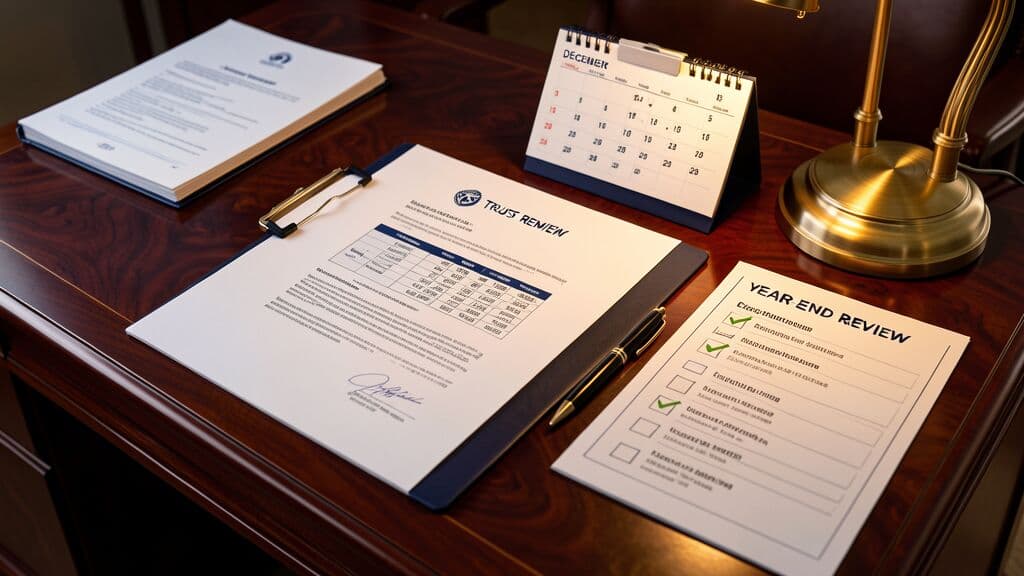
Why Year-End Trust Reviews Matter
The year-end trust review is one of the trustee’s most critical administrative tasks. It serves a dual purpose: (1) documenting the trustee’s ongoing performance and fiduciary duties, and (2) gathering the information needed to prepare the trust’s annual tax return. Meeting minutes that thoroughly document this review provide evidence of proper administration, help prevent disputes, and ensure compliance with state laws and IRS requirements. Understanding what are trust minutes and their role in trust administration is essential for conducting an effective year-end review.
Three Pillars of Year-End Review
Asset Valuation
Document current market values of all trust assets and assess appreciation/depreciation throughout the year.
Income & Expenses
Summarize all trust income, expenses, and distributions for tax reporting and beneficiary communication.
Compliance & Updates
Check state requirements, update beneficiary information, review trust document amendments, and plan for distributions.
Proper documentation of the year-end review demonstrates that the trustee has fulfilled their fiduciary duty to administer the trust prudently and in accordance with the trust instrument and applicable law. When beneficiaries have questions about trust performance or distribution decisions, the meeting minutes become a key source of information and potential points of disagreement. A comprehensive review with thorough documentation minimizes the risk of future disputes and protects the trustee from liability.
Essential Components of Year-End Review Minutes
Effective year-end trust review minutes should cover six fundamental areas. Each section serves a specific purpose: legal compliance, tax reporting, fiduciary documentation, and beneficiary communication. Following a consistent trust minutes format ensures your documentation is thorough and well-organized.
1. Trust Asset Review and Valuation
Document the current market value of each major asset category: cash and cash equivalents, investments (stocks, bonds, mutual funds), real property, business interests, retirement accounts, and other tangible personal property. Include a comparison to the prior year's valuation to show appreciation or depreciation, and explain significant changes that justify variance. This information is essential for calculating trust income and determining year-end tax basis.
Documentation checklist:
- List each asset class with description, current value, and year-to-date change
- Document the valuation method (fair market value, appraisals, broker statements)
- Note any revaluations required due to market movements or property assessments
- Explain substantial deviations from prior year values
2. Trust Income Summary
Aggregate all sources of trust income: interest, dividends, rental income, capital gains, royalties, partnership income, and other revenue. Categorize by type and provide a year-to-date total for each category. This summary serves as the foundation for trust tax reporting and is distributed to beneficiaries in the form of Schedules K-1 or other beneficiary statements.
Documentation checklist:
- Interest income by type (bank, muni, corporate, etc.)
- Dividend income by common, preferred, qualified, and non-qualified
- Rental property income and expense allocation
- Capital gains/losses realized during the year
- Other income streams (royalties, estate settlements, etc.)
3. Trust Expenses Summary
Document all administrative and investment expenses incurred during the trust year. These include trustee fees, accounting fees, legal counsel fees, investment advisory fees, brokerage commissions, property taxes, insurance premiums, maintenance and repair costs for real estate, and other costs of administration. Each expense should be tied to a specific action that advanced the administration of the trust.
Documentation checklist:
- Trustee fee schedule with dates and amounts
- Professional fees: legal, accounting, tax preparation, consulting
- Investment-related expenses: management fees, transaction costs
- Property taxes and insurance
- Maintenance and operating expenses for real estate held in trust
- Unexpected expenses requiring special authorization or explanation
4. Beneficiary Distributions
Record all distributions made to beneficiaries during the trust year, including dates, amounts, and payment methods. Document any conditions or restrictions attached to distributions (e.g., for education, health, maintenance, or support). If discretionary distributions were made based on a power of appointment, record the trustee's reasoning and the factors considered in reaching the decision.
Documentation checklist:
- Distribution date(s) and amount(s)
- Beneficiary name(s) and relationship to settlor
- Purpose or condition of distribution (e.g., education, medical)
- Payment method (check, electronic transfer, property delivery)
- Tax withholding information and distribution classification (income, corpus, or principal)
- Any beneficiary consent or waiver documentation
5. Tax Form Information and 1099 Filings
Document the need and timing for tax forms related to the trust. This includes determining which beneficiaries receive Schedule K-1s based on the type of income allocated to them, verifying 1099-INT and 1099-DIV information for reporting to beneficiaries, and initiating Form 1041 or 1041-S for the trust itself. Note any estimated tax payments made or adjustments to prior-year filings.
Documentation checklist:
- Schedule K-1 allocations to each beneficiary (by income type)
- 1099 forms received from third parties (interest, dividends)
- Form 1041 estimated tax payments made during the year
- State tax requirements (PA-41 for Pennsylvania resident trusts)
- Year-end basis adjustments from capital gains distributions
- 945/941 withholdings if applicable
6. Beneficiary Updates and Consents
Document changes in beneficiary circumstances, including births, deaths, marriages, divorces, emancipations, or changes in financial status. Record any requests or requests for information from beneficiaries, and document any consent or agreement required for subsequent actions (e.g., beneficiary consent to trust modifications). This section updates the beneficiary roster and confirms current contact information.
Documentation checklist:
- Births, deaths, marriages, divorces among beneficiaries
- Changes in trustee or successor trustee appointments
- Updated beneficiary contact information (address, telephone, email)
- Requests for trust accounting or current status
- Beneficiary consent for any amendments or administrative changes
- Notification of beneficiary rights to information and accounting of trust performance
IRS Form 1041 and Year-End Review
The year-end trust review provides the foundation for preparing the trust’s federal income tax return, Form 1041, U.S. Income Tax Return for Estates and Trusts. Meeting minutes should document the information needed to complete the return correctly and support any distributions, deductions, or credits taken.
When Is Form 1041 Required?
A simple living trust typically does not pay income tax, so Form 1041 is not required in most cases. However, Form 1041 must be filed in any of the following scenarios:
- The trust has gross income from sources within the US that is at least $600
- The trust has at least one beneficiary who is a U.S. citizen or resident
- The trust has required distributions to beneficiaries
- The trust has generated capital gains or losses requiring reporting
- The trust has complex income allocations (e.g., unrelated business taxable income)
Schedule K-1 Requirement
If the trust is required to file Form 1041, it must also prepare Schedule K-1 (Form 1041) for each beneficiary. The year-end review meeting minutes should document which beneficiaries receive allocations of trust income, the types of income allocated to each beneficiary, and any special tax treatments (e.g., capital gains, foreign sourced income, etc.).
Income Reported on K-1
Interest, dividends, rental income, capital gains, partnership income, royalty income, and other trust-generated income.
Corpus/Principal Receipts
Principal distributions (not currently taxable) should be separately documented from income allocations.
Meeting minutes that accurately record the income and expense categories, distribution classifications, and beneficiary allocation methodology provide the documentation needed to complete Form 1041 correctly and support any questions raised by the IRS or beneficiaries. This documentation is particularly important for trusts with complex income sources or when beneficiary disputes arise about whether distributions were proper allocations of income versus principal.
Year-End Trust Review Checklist
Use this checklist as a guide to ensure your year-end trust review is comprehensive and that your meeting minutes capture all legally required information. A trust minutes template can help structure your review and ensure nothing is overlooked.
Pre-Meeting Preparation (1-2 weeks before year-end)
During Review Meeting
Post-Meeting (Within 1 week)
Fiduciary Duty Considerations
The year-end trust review meeting serves as a pivotal moment for satisfying the trustee’s fiduciary duty to administer the trust prudently and in accordance with the trust instrument. Proper documentation of this review satisfies the duty of loyalty (ensuring decisions are made for beneficiary welfare, not personal gain) and the duty of care (making informed decisions with reasonable scrutiny of the available information). Meeting these trust record keeping requirements protects the trustee and demonstrates compliance with fiduciary obligations.
Duty to Keep Beneficiaries Informed
Most trust laws, including the Uniform Trust Code, require trustees to keep beneficiaries reasonably informed about material information related to trust administration. The year-end review meeting provides the ideal forum to share information about trust performance, income, expenses, and distributions made during the year. Meeting minutes that document this communication help demonstrate compliance with the informedness requirement.
- Document attendance at the annual meeting and those represented by proxy
- Note beneficiary questions asked and responses provided by the trustee
- Record any information provided about trust assets, income, and distributions
- Note any beneficiary requests for additional information or accounting
- Document any decisions to withhold information and the trustee’s reasoning
Tax Discretion Distributions
For discretionary trusts, the trustee must make judgment calls about which beneficiaries receive distributions and in what amounts. The year-end review meeting is an ideal time to document the trustee’s reasoning for distributions made during the year and to justify any discretionary decisions. Courts have upheld discretionary distributions when the trustee can show that the decision was reasonable, well-reasoned, and aligned with the trust’s terms and beneficiary needs.
Meeting minutes should explicitly record: (1) the distribution amounts, (2) the beneficiaries receiving distributions, (3) the relationship of distributions to trust terms or the trustee’s discretion, (4) the beneficiary circumstances that warranted the distribution, and (5) any alternatives considered and why they were not chosen. This documentation is critical if a beneficiary later challenges the distribution as improper.
By conducting a thorough year-end review and documenting it comprehensively in meeting minutes, the trustee creates a paper trail that demonstrates thoughtful administration, protects against future liability, and helps maintain trust relationships with beneficiaries.
Best Practices for Year-End Review Minutes
Trust administrators should follow these best practices to ensure that year-end review meeting minutes are comprehensive, legally sound, and serve their intended purpose. Learning how to write trust minutes effectively is the foundation for all trust documentation. When ready to draft your review, use the TrustMinutes wizard to generate professional minutes in minutes.
Document Everything Discussed
Don’t summarize - record every decision, discussion, question, and response in detail. The meeting minutes are the official record of the trustee’s decision-making process, not just the outcomes.
Time Stamps and Attendees
Include the date and time of the meeting, attendees present either in person or by phone/web, and those represented by proxy. This establishes the official record of who participated.
Rationale for Key Decisions
For discretionary distributions, investment changes, and other significant decisions, include the trustee’s reasoning, the alternatives considered, and why the selected path was chosen.
Action Items
Document any follow-up actions required, including who is responsible, by what date, and any resources or approvals needed. These become action items for the next trustee meeting.
Reference Legal Authorities
When referencing trust terms, state statutes, or case law, include the specific citation or reference. This strengthens the legal defensibility of the decisions made.
Beneficiary Consents in Writing
If any beneficiary consent was required for an administrative change, record that consent in the minutes and retain the signed consent documents separately for safekeeping.
Benefits of Comprehensive Year-End Documentation
- Protects the trustee from liability by documenting thoughtful, informed decisions
- Prevents beneficiary disputes by providing contemporaneous evidence of the trustee’s reasoning and the information available at the time of decision
- Facilitates smooth tax administration by ensuring all income, expenses, and distribution classifications are documented for Form 1041 and 1099/K-1 reporting
- Strengthens beneficiary trust by demonstrating transparency and the trustee’s commitment to prudent administration
- Satisfies fiduciary duty to keep beneficiaries adequately informed about trust administration
- Supports successor trustees by providing a complete history of past decisions and circumstances that influenced them
 Looking for ongoing trust governance? Explore TrustOffice
Frequently Asked Questions
When is the deadline for year-end trust review and annual meeting?
Trust year-end reviews and annual meetings should ideally occur before December 31st of each year. However, distribution decisions and finalizing Form 1041, Schedule K-1, and 1099 forms are due by April 15th. Many trustees schedule the review-meeting before year-end to align with distribution timing, but all documentation must be complete by the tax-filing deadline to satisfy fiduciary duty documentation requirements. Meeting minutes should be signed at or shortly after the review meeting to guarantee contemporaneous documentation.
What expenses should be included in a year-end trust accounting review?
Include all administrative expenses: trustee fees, accounting fees, legal counsel for trust modifications or disputes, property taxes for real estate held in the trust, insurance premiums, maintenance costs for trust property, investment advisory fees, brokerage commissions, and any extraordinary expenses. Ordinary living expenses of trust beneficiaries should only be documented when specifically authorized by the trust instrument. Each expense should be clearly tied to specific administrative actions documented in the meeting minutes.
How often must trustees make beneficiary distributions?
Distribution frequency is dictated by the trust instrument, not law. Income-only trusts distribute all net rental income and dividend income annually. Unitrust or percentage trusts may make discretionary decisions based on trust purpose and beneficiary needs. Some trusts require distributions annually; others may allow for discretionary timing. The year-end meeting minutes should explicitly record the trustee's distribution decisions and rationale, documenting compliance with the trust terms.
Do trustees need to prepare federal tax returns for the trust?
A simple living trust does not pay income tax, so no Form 1041 is required. However, complex trusts with accumulated income, complex income allocations, or income attributed to the settlor for estate tax purposes must file Form 1041, U.S. Income Tax Return for Estates and Trusts. The year-end review meeting minutes should document all income types and distribution classifications to support accurate tax reporting required by the IRS.
What is a Schedule K-1 from a trust, and who receives one?
Schedule K-1 is an IRS form used to report a beneficiary's share of a trust's income, credits, and deductions. Beneficiaries receive a copy and must report their allocated income on their personal tax returns. The year-end meeting minutes document the income allocation methodology and respective K-1 amounts per beneficiary, ensuring transparency and meeting fiduciary duty documentation requirements for tax compliance.
How do I classify distributions as income versus principal for tax purposes?
Distributions must be classified as income, principal, or corpus for tax reporting. Income includes current earnings: interest, dividends, rental income, short-term capital gains. Principal (corpus) distributions reduce the trust's underlying assets and are not currently taxable. The year-end review meeting minutes must document each distribution classification, citing the rationale based on trust language, IRS regulations, and the nature of the income stream. This documentation supports proper tax reporting and protects against questions about distribution timing and appropriateness.
What happens if the trustee fails to conduct a proper year-end review?
Failing to conduct a comprehensive year-end review and document it in minutes violates fiduciary duty to administer the trust prudently and keep beneficiaries informed. The consequences include: potential beneficiary disputes over distributions or administration, increased liability for breach of duty, difficulty defending discretionary decisions in court, challenges to the trustee's fee, and potential removal of the trustee for insufficient administration. Trust minutes documenting the review provide a critical paper trail that protects the trustee and satisfies the duty to keep beneficiaries informed.
Should the trustee share the year-end review summary with beneficiaries?
Many trust documents require trustees to provide annual beneficiary statements. The year-end review meeting itself is a communication opportunity, and discussing the review results satisfies the duty to keep beneficiaries reasonably informed. Meeting minutes should document any information shared with beneficiaries, any questions asked and answered, and any requests for additional information. Even if your trust does not explicitly require annual statements, sharing an executive summary of the year-end review demonstrates good administration and helps maintain trust relationships.
Related Trust Minutes Guides
Annual Review Meeting Minutes
Comprehensive annual administration meetings with beneficiary updates, performance reviews, and planning.
Irrrevocable Trust Meeting Minutes
Documentation requirements and compliance considerations specific to irrevocable trusts and their preservation value.
Trust Distribution Minutes
Proper documentation of distributions to beneficiaries, including verification compliance and distribution decision rationales.
Trust Minutes Template
Use our free trust minutes template to document meetings efficiently. Includes sections for attendance, discussions, decisions, and record requests.
Advertisement