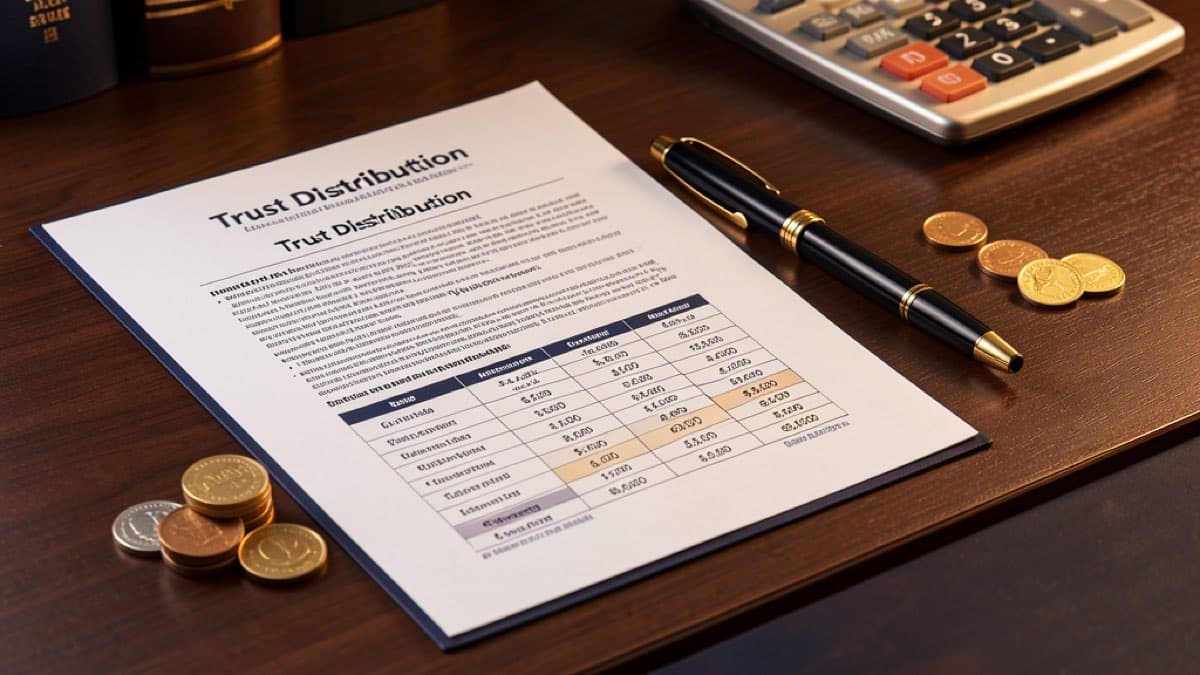
Distributions vs. Disbursements: Why the Meeting Matters
Trustees often use the words distribution and disbursement interchangeably, but the meeting process for authorizing each has distinct procedural requirements. A distribution is the transfer of trust assets to a beneficiary under the trust instrument. A disbursement is any payment leaving the trust — which may include distributions to beneficiaries, but also covers payment of trustee fees, professional invoices, taxes, and administrative expenses. The meeting minutes documenting these two actions share a common structure, but the considerations the trustee must record differ in important ways.
Distribution-and-disbursement meeting minutes exist to answer a single question: was the trustee’s decision to move trust funds properly authorized, properly deliberated, and adequately recorded? A cancelled check or wire confirmation shows that money moved, but it does not show the deliberation that preceded the transfer. Only the meeting minutes capture the who, the why, the authority cited, and the basis for the decision — which is why courts, beneficiaries, and tax authorities treat the minutes as the primary record, not the bank statement.
This guide focuses specifically on the meeting process for approving distributions and disbursements: calling the meeting, conducting deliberation, recording the motion and vote, and preserving the record. For the substantive content of a single distribution decision — what to include in the resolution itself — see our companion guide to trust distribution minutes.
Meeting Formats for Approving Distributions
Trust instruments and state law determine which meeting formats are permissible for approving a distribution or disbursement. Three formats are common, and the minutes should clearly identify which was used:
In-Person Meeting
A traditional meeting where the trustee (or co-trustees) gather to deliberate and vote. The minutes should record the date, time, and location; the names and capacities of those present; and any guests (attorney, accountant, beneficiary representative) and the reason for their attendance. In-person meetings are most common for large discretionary distributions, contested distributions, or the first distribution after a successor trustee takes over.
Telephone or Video Conference
Most state trust statutes and the Uniform Trust Code permit trustees to conduct meetings by phone or video, provided all participants can hear one another simultaneously. The minutes should identify the platform used (e.g., "Zoom video conference"), list the participants, and note that all participants could communicate in real time. Co-trustee consent to the remote format should be recorded if the trust instrument requires it.
Unanimous Written Consent (Action Without a Meeting)
Many trusts allow trustees to act without holding a meeting by signing a written consent that sets forth the action taken. While no deliberative meeting occurs, the consent document still functions as the "meeting minutes" and must include the same elements: the authority cited, the deliberation summary, the action approved, and the signatures of all trustees entitled to vote. Note that some trusts prohibit written consent for certain distributions — always verify the trust instrument’s requirements.
The Distribution Meeting Agenda
A well-run distribution meeting follows a predictable agenda. Capturing each agenda item in the minutes — even when the discussion was brief — is what separates a defensible record from a vulnerable one. Use this agenda as the backbone of your minutes:
Standard Distribution Meeting Agenda
- Call to order: The meeting is called to order; the date, time, location (or virtual platform), and presiding trustee are recorded.
- Quorum and attendance: The minutes confirm that a quorum is present and identify each trustee, their capacity, and any other attendees.
- Review of trust instrument: The trustee identifies the specific provision authorizing the proposed distribution or disbursement.
- Financial review: The trustee reviews available trust assets, liquidity, and any pending obligations to confirm the distribution is feasible.
- Beneficiary presentation: For discretionary distributions, the beneficiary’s request and supporting documentation are summarized.
- Deliberation: The trustee records the factors considered — beneficiary need, trust purpose, tax impact, equal-treatment concerns.
- Motion and vote: A formal motion is made, seconded (if required), and voted upon. The vote tally is recorded.
- Authorization of payment: The minutes authorize the specific disbursement — amount, payee, method, and date.
- Recordkeeping directive: The minutes direct that the resolution be filed with the trust records and any required notices sent.
- Adjournment: The meeting is adjourned; the next meeting date is set if applicable.
For routine or administrative disbursements (e.g., paying the trust’s annual tax preparation invoice), this agenda can be compressed into a short written consent. For discretionary distributions to beneficiaries, the full agenda should be followed and each item documented in the minutes.
Recording the Motion and Vote
The motion and vote are the heart of the distribution meeting minutes. A properly recorded motion names the trustee who made the motion, the trustee who seconded it (if required), and the exact wording of the action approved. The vote tally — unanimous, majority, or split — must be recorded along with the names of any dissenting trustees and the basis for their dissent.
For trusts with co-trustees, the trust instrument specifies whether unanimity or majority consent is required to authorize a distribution. The minutes must reflect the actual voting rule applied. If a co-trustee abstains or dissents, that position must be recorded — silence in the minutes is not enough. A dissenting trustee who fails to record their dissent in the minutes may be presumed to have concurred, which can later defeat a defense based on disagreement with the distribution.
Critical: Record Dissents in the Minutes
A co-trustee who disagrees with a distribution musthave their dissent recorded in the meeting minutes. Under the Uniform Trust Code and most state statutes, a trustee who fails to record a dissent may be held jointly liable for the consequences of the distribution, even if they personally voted against it. The minutes are the legal mechanism for preserving a dissenting trustee’s protection.
When a distribution is approved by written consent rather than a meeting, the consent document should include a statement that the action was approved by the unanimous written consent of the trustees entitled to vote, the date each trustee signed, and the effective date of the action. Consents may be signed in counterparts and circulated electronically, provided the trust instrument permits it.
When to Hold the Meeting: Timing Requirements
The timing of the distribution meeting matters as much as its content. Best practice is to hold the meeting before the distribution is made, so the authorization precedes the transfer. When a meeting is held after the distribution — for example, to ratify an emergency HEMS disbursement — the minutes should clearly label the action as a ratification, state the original disbursement date, and explain why contemporaneous authorization was not possible.
For mandatory distributions (such as an annual income distribution to a surviving spouse), the meeting should be held at or near the date specified in the trust instrument. If the trust requires the distribution by a particular date and the meeting is held late, the minutes should not backdate the authorization — instead, record the actual meeting date and note that the distribution was made in compliance with the trust’s timing requirement, attaching the prior authorization if one exists.
Timing Best Practices by Distribution Type
- Mandatory income distributions: Hold the meeting at the start of the distribution period so authorization precedes payment.
- Discretionary distributions: Hold the meeting only after the beneficiary’s request and supporting documentation are complete; do not authorize speculatively.
- Emergency HEMS distributions: Document the urgency in the meeting minutes; ratify in the next regularly scheduled meeting if contemporaneous authorization was impossible.
- Year-end distributions: Coordinate with the trust’s tax preparer; meeting minutes should reflect any tax-planning considerations that drove the timing.
Notice, Quorum, and Beneficiary Participation
Some trust instruments require formal notice of trustee meetings, particularly when a beneficiary has the right to attend or receive information. The minutes should record whether notice was required, when and how it was given, and whether any beneficiary or their representative attended. Even when notice is not required, inviting a beneficiary (or their counsel) to attend a discretionary-distribution meeting can strengthen the record by demonstrating that the decision was made transparently.
Quorum requirements are typically defined in the trust instrument. For a sole trustee, the trustee’s presence is the quorum. For co-trustees, the trust usually requires all trustees to participate unless it permits majority action. The minutes should explicitly state that a quorum was present and identify the rule applied (e.g., "the Trust instrument requires unanimous consent of all co-trustees for distributions; both co-trustees were present and voted").
When a beneficiary attends the meeting, the minutes should record their presence, whether they addressed the trustees, and the substance of any statement they made. Beneficiary participation does not give the beneficiary a vote, but it creates a record that the trustees considered the beneficiary’s perspective — which can be decisive if the distribution is later challenged as biased.
Common Procedural Errors in Distribution Meetings
Most challenges to trust distributions succeed not because the distribution itself was wrong, but because the trustee failed to follow the correct procedure. These are the procedural errors that most often undermine an otherwise defensible distribution:
Skipping the Meeting for "Simple" Distributions
Trustees routinely skip the meeting step for routine distributions, reasoning that the transfer is straightforward. But a distribution made without any recorded authorization is effectively undocumented, and the trustee bears the burden of justifying it after the fact. Even a one-paragraph written consent is better than nothing — learn how to write trust minutes that satisfy the minimum procedural requirement.
Backdating the Meeting
When a trustee realizes a meeting should have been held before a distribution was made, the temptation is to backdate the minutes. Never do this. Backdated minutes are fraud and will destroy the trustee’s credibility in any proceeding. The correct response is to hold the meeting now, label the action as a ratification, and explain the original authorization gap honestly.
Failing to Record a Co-Trustee’s Dissent
A co-trustee who disagrees with a distribution but does not have their dissent recorded in the minutes is generally presumed to have concurred. This presumption can expose the dissenting trustee to joint liability. If you are a dissenting co-trustee, insist that your dissent — and your reasons — be entered into the minutes before you sign them.
Conflating the Resolution With the Minutes
The distribution resolution is the formal action; the meeting minutes are the procedural record surrounding it. Drafting a resolution and treating it as the complete record omits the deliberation, attendance, and vote that make the record defensible. The minutes should contain or reference the resolution, not substitute for it.
How to Write Distribution & Disbursement Meeting Minutes
Use a consistent template for every distribution meeting so the procedural elements are never omitted. The following structure works for both formal meetings and written consents:
Minutes Structure
| Section | What to Record |
|---|---|
| Header | Trust name, meeting date, time, location or platform, format (in-person / virtual / written consent). |
| Attendance | Each trustee present and their capacity; quorum confirmation; any beneficiaries or advisors present and their role. |
| Authority cited | The specific provision of the trust instrument (e.g., "Article IV, Section 4.2 — discretionary HEMS authority") authorizing the action. |
| Deliberation | The factors considered: beneficiary need, trust liquidity, tax impact, equal-treatment concerns, and any professional advice received. |
| Motion and vote | The exact wording of the motion, who made and seconded it, the vote tally, and any recorded dissents with reasons. |
| Disbursement authorization | Amount, payee, payment method, and target disbursement date. |
| Signatures | Signatures of all trustees entitled to vote, with dates; notarization if required by the trust instrument. |
For a deeper walkthrough of the writing process, including language samples and formatting tips, see our comprehensive guide on how to write trust minutes. For the substantive content of a single distribution resolution, see the companion trust distribution minutes guide.
Frequently Asked Questions
Do I need a formal meeting to approve a routine trust disbursement?
Not always. Most state trust statutes and the Uniform Trust Code permit trustees to act by unanimous written consent in lieu of a meeting, provided the trust instrument does not prohibit it. For routine administrative disbursements — paying the trust’s tax-preparation invoice, for example — a short written consent is often sufficient. For discretionary distributions to beneficiaries, a formal meeting (even a brief one) is strongly preferred because the deliberation record is what makes the distribution defensible.
Can a distribution meeting be held remotely?
Yes, in nearly all jurisdictions. Trustees may meet by telephone or video conference as long as all participants can communicate simultaneously. The minutes should identify the platform used (e.g., "Zoom video conference") and confirm that all participants could hear one another in real time. Some trust instruments require in-person meetings for certain actions, so verify the instrument’s requirements before relying on a remote format.
What if a co-trustee disagrees with the distribution?
A dissenting co-trustee should have their dissent — and the reasons for it — recorded in the meeting minutes before the minutes are finalized and signed. A trustee who fails to record a dissent is generally presumed to have concurred and may be held jointly liable for the consequences of the distribution. Recording the dissent is the legal mechanism that preserves the dissenting trustee’s protection; verbal disagreement is not enough.
Does a beneficiary have the right to attend the distribution meeting?
Only if the trust instrument grants that right. The Uniform Trust Code does not give beneficiaries a general right to attend trustee meetings, but some trusts specifically require notice of, or attendance at, meetings involving discretionary distributions. Even when not required, inviting a beneficiary (or their counsel) to attend can strengthen the record by demonstrating the decision was made transparently. If a beneficiary attends, the minutes should record their presence and any statement they made.
Can I ratify a distribution after the fact in the meeting minutes?
Yes, but the ratification must be honestly labeled. If a distribution was made before a meeting could be held (for example, an emergency HEMS payment), the subsequent meeting minutes should describe the original disbursement date, explain why contemporaneous authorization was not possible, and ratify the action. Never backdate the minutes to make it appear the meeting preceded the distribution — backdated minutes are fraud and will destroy the trustee’s credibility.
What is the difference between these meeting minutes and a trust distribution resolution?
The distribution resolution is the formal action that authorizes a specific distribution. The meeting minutes are the procedural record surrounding that action — who attended, what authority was cited, what was deliberated, and how the vote was taken. The minutes typically contain or attach the resolution. For the substantive content of the resolution itself (required elements, distribution types, retention), see our companion trust distribution minutes guide.