Free Trust Resolution Template
Create professionally formatted trust resolutions in minutes. Our free trust resolution template gives you the framework every trustee needs to document decisions clearly, comply with fiduciary duties, and protect the trust and yourself from future disputes.
What Is a Trust Resolution Template?
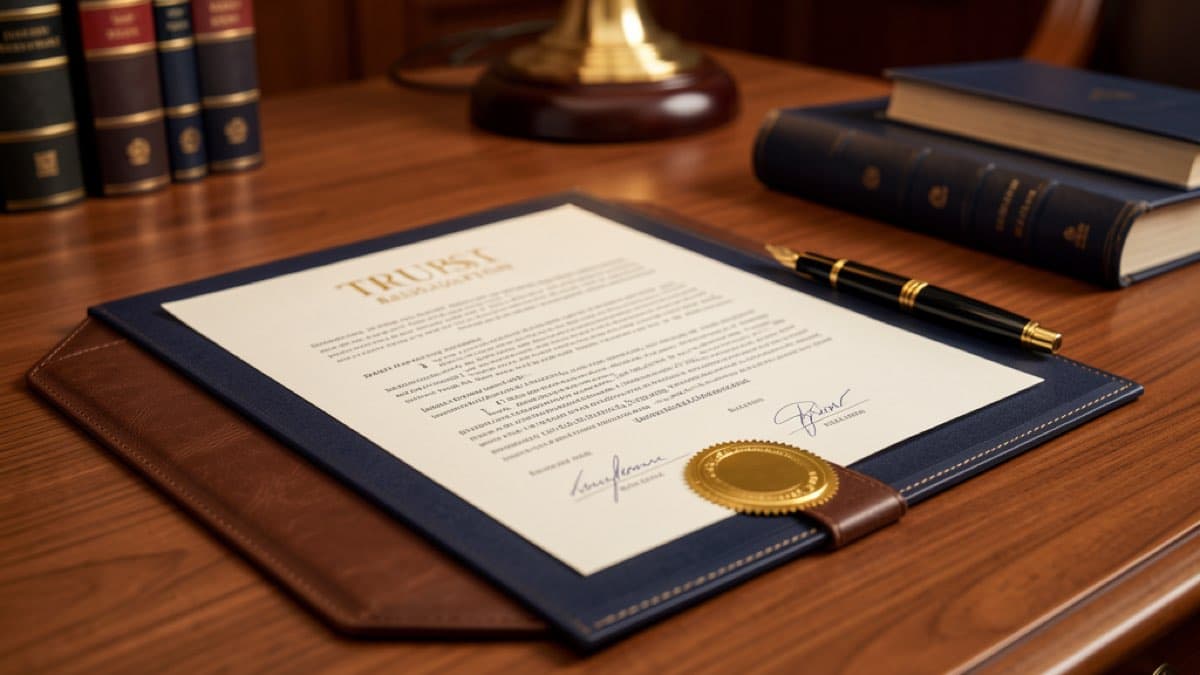
A trust resolution template is a standardized document framework that trustees use to formally record decisions made on behalf of a trust. Whether you are authorizing a distribution to a beneficiary, opening a bank account, selling trust property, or adopting an investment policy, a trust resolution document serves as the official written proof that the trustee acted within their authority.
Unlike informal notes or emails, a properly formatted trustee resolution form carries legal weight. Banks, title companies, courts, and other third parties routinely require a signed trust resolution before they will act on instructions from a trustee. Using a reliable template ensures that every required element, from recitals and authority citations to vote tallies and notary blocks, is present and correctly structured.
For a broader understanding of how resolutions fit into trust record-keeping, see our guide on what trust minutes are and why they matter. For retention rules, see our page on trust record keeping requirements.
Why Every Trustee Needs a Trust Resolution Document
Fiduciary Protection
A written resolution demonstrates that you acted prudently and within the scope of your authority. Your strongest defense against claims of breach of fiduciary duty.
Third-Party Compliance
Financial institutions, title companies, and government agencies frequently require a signed trust resolution before processing transactions on behalf of a trust.
Record-Keeping Best Practice
Trust law in most states requires trustees to maintain accurate records. Resolutions form a core part of the trust's permanent documented history.
Dispute Prevention
Clearly documented decisions reduce ambiguity and disagreement among trustees and beneficiaries, preventing costly conflicts down the line.
Key Elements of a Trust Resolution Template
A complete trust resolution document must include several essential components. Omitting even one can render the resolution ineffective or unenforceable. Here is what every trustee resolution form should contain:
- Trust Identification: The full legal name of the trust, the date it was established, and the name(s) of the settlor(s). This ensures the resolution is tied to the correct trust instrument.
- Date and Location: The date the resolution is adopted and the location where the trustee(s) are acting. This matters for determining which state law applies.
- Trustee Identification: The full legal names and titles of every trustee participating in the resolution. If there are multiple trustees, list each one.
- Recitals (WHEREAS Clauses): Background facts and the authority under which the trustee is acting. Recitals provide context and connect the resolution to specific provisions in the trust agreement.
- Resolution (RESOLVED Clauses): The specific action being authorized or decision being made. This is the operative portion of the document and should be stated clearly and unambiguously.
- Vote Record: If the trust has multiple trustees, document how each voted (in favor, opposed, or abstained). This is particularly important for trustee meeting minutes and board-style resolutions.
- Signature Blocks: Signature lines for each participating trustee, with printed name, title, and date.
- Notary Acknowledgment: A notary block for situations where the resolution must be notarized, common for real estate transactions and financial account changes.
Need a broader framework for documenting trust business? Our trust minutes template covers the full spectrum of trust record-keeping.
Common Types of Trust Resolutions
Trust resolutions are not one-size-fits-all. Different situations call for different types of trustee resolution forms. Below are the most common categories:
Trust Distribution Resolution
Perhaps the most frequently used resolution, a trust distribution resolution authorizes the trustee to make a distribution to one or more beneficiaries. A comprehensive trust distribution resolution templateshould include the distribution amount, the beneficiary's name, the provision in the trust agreement authorizing the distribution, and any conditions or restrictions that apply. For detailed guidance on documenting these, see our trust distribution minutes resource.
Trust Property Sale Resolution
When a trustee sells trust-held real estate or other significant assets, a formal resolution documents the terms of the sale, confirms the price is fair, and authorizes the trustee to execute the necessary paperwork. Title companies almost always require this resolution before closing.
Bank Account and Investment Resolutions
Opening, closing, or changing signatories on trust bank accounts; reallocating investment portfolios; or adopting an investment policy statement, all require a formal trust resolution document that the financial institution will keep on file.
Trustee Appointment or Resignation
When a new trustee is appointed or an existing trustee resigns, a resolution formally documents the change in leadership and the effective date, so the chain of authority is clear.
Administrative and Tax Resolutions
Filing tax returns, electing tax treatment, authorizing legal representation, or responding to legal claims. These administrative actions also benefit from formal trustee resolution forms that create a paper trail of prudent decision-making.
How to Write a Trust Resolution
Writing a trust resolution from scratch can be daunting, which is exactly why using a trust resolution template is so valuable. Here is the step-by-step process:
- Identify the trust and governing law. Pull the exact legal name from the trust agreement and note the governing state. Every resolution must anchor to these foundational facts.
- State the authority. Cite the specific provision of the trust agreement (or applicable statute) that gives the trustee the power to take this action. This is the legal basis for the resolution.
- Write the recitals.Use “WHEREAS” clauses to lay out the background facts. Think of recitals as the story that leads up to the decision. They explain why the trustee is acting.
- Craft the resolution.Use “RESOLVED” clauses to state the decision in clear, specific language. Avoid ambiguity. The resolution should be self-explanatory without needing outside context.
- Document the vote.If there are multiple trustees, record each trustee's vote. Specify whether unanimous consent was obtained or if the decision was made by majority.
- Execute properly. All participating trustees must sign and date the resolution. If notarization is required (check state law and institutional policies), have the document notarized at the time of signing.
- File and store. Keep the original in the trust records and distribute copies to co-trustees, beneficiaries, and any relevant third parties.
For a deeper dive into drafting trust documents, check out our guide on how to write trust minutes.
What's Included in This Template
Complete Resolution Examples
Three fully completed trust resolutions shown as document mockups. Each illustrates the structure, language, and authority citations you should expect in a properly executed trustee resolution.
Example 1 — Trust Distribution Resolution
WHEREAS, the Trustee holds authority under Article V, Section 5.02 of the Hartwell Family Legacy Trust Agreement dated June 14, 2016 to make distributions of net income to the beneficiaries named therein;
WHEREAS, the Trustee has reviewed the trust’s financial statements for the fiscal year ended December 31, 2024, and has determined that the net income available for distribution is Forty-Two Thousand Five Hundred Dollars ($42,500.00);
WHEREAS, the Trustee has considered the needs and circumstances of each beneficiary consistent with the standard of Section 5.03 of the Trust Agreement and the Idaho Uniform Trust Code (Idaho Code Title 68, Chapter 5);
NOW, THEREFORE, BE IT RESOLVED that the Trustee hereby directs the distribution of the net income for fiscal year 2024 as follows:
BE IT FURTHER RESOLVED that the Trustee is authorized and directed to execute all documents and take all actions necessary to effectuate the foregoing distributions.
The authority citation (Article V, Section 5.02) ties this distribution directly to the trust agreement. Without it, the resolution lacks legal foundation.
Every beneficiary is listed, including Caroline who receives $0. Listing $0 recipients is best practice — it shows the trustee considered all beneficiaries and documents why no distribution was made to that person.
The totals reconcile to the stated net income ($42,500). Internal consistency between the recitals and the resolution table is essential — discrepancies invite disputes.
Example 2 — Trust Property Sale Resolution
WHEREAS, the Trust holds fee title to the real property commonly known as 4827 Cottonwood Lane, Sacramento, California (APN 027-441-018), acquired by the settlor in 2009 (the “Property”);
WHEREAS, the Trustee possesses authority to sell trust property under Article VII, Section 7.04 of the Riverside Heritage Trust Agreement dated November 3, 2009, and California Probate Code Section 16247(a) of the Uniform Trust Code;
WHEREAS, the Trustee conducted an investment review on June 24, 2025, obtained an independent appraisal from Westgate Valuation Group dated June 20, 2025 establishing a fair market value of $685,000, and reviewed comparable sales within a one-mile radius;
WHEREAS, the Trustee received a bona fide purchase offer from Michael and Linda Reyes in the amount of $672,000, which the Trustee determined to be fair and reasonable and in the best interests of the beneficiaries after considering carrying costs, market conditions, and the trust’s liquidity needs;
NOW, THEREFORE, BE IT RESOLVED that the Trustee hereby authorizes and directs the sale of the Property to Michael and Linda Reyes at a purchase price of Six Hundred Seventy-Two Thousand Dollars ($672,000.00), subject to the terms of the Purchase and Sale Agreement dated July 7, 2025;
BE IT FURTHER RESOLVED that the Trustee is authorized to execute the deed, escrow instructions, and all closing documents necessary to consummate the sale, and to deposit the net proceeds into the Trust’s investment account at First National Bank.
Two authority citations are referenced: the trust agreement provision AND the state Uniform Trust Code statute. Citing both strengthens the legal basis and satisfies title-company requirements.
The investment review is documented — appraisal, date, and comparable sales. This is the trustee’s fiduciary shield: it proves the price was investigated, not guessed, which is critical under the Prudent Investor Rule.
A notary block is included. Real estate sales almost always require notarization — the title company will reject an unnotarized trustee resolution.
Example 3 — Investment Policy Adoption Resolution
WHEREAS, the Trustee is granted investment authority under Article VI of the Aldridge Educational Trust Agreement dated September 12, 2014, and is subject to the Prudent Investor Rule as codified in Texas Trust Code Section 113.051 (Texas Uniform Trust Code Section 901);
WHEREAS, the Trustee has determined that the adoption of a formal written investment policy statement is consistent with the duty of prudence and will guide the management and deployment of trust assets in accordance with the trust’s long-term educational-distribution objectives;
NOW, THEREFORE, BE IT RESOLVED that the Trustee hereby adopts the Aldridge Educational Trust Investment Policy Statement dated February 11, 2025 (the “Policy”), which establishes the following asset allocation targets:
BE IT FURTHER RESOLVED that the Trustee shall review the portfolio no less frequently than annually, rebalance to the target ranges when any asset class drifts beyond the stated bands, and document each review in the trust records;
BE IT FURTHER RESOLVED that the Trustee is authorized to engage a qualified investment advisor to assist in implementing the Policy, subject to the Trustee’s continuing duty to monitor such advisor.
The Prudent Investor Rule is cited by statute. This is the governing legal standard for trust investing — documenting it shows the trustee acted with the required care, skill, and caution.
Asset allocation targets use ranges, not fixed percentages. Tolerance bands (±) give the trustee discretion while staying within prudent limits — a hallmark of a well-drafted investment policy.
The annual review and rebalancing duty is written into the resolution itself. This commits the trustee to ongoing monitoring — the duty does not end at adoption.
Trust Resolution vs. Trust Minutes
They are related but serve different purposes. Use this side-by-side comparison to choose the right document for the situation.
- A third party (bank, title company, court) requires proof of a trustee decision
- A single, specific action needs authorizing — distribution, sale, account change
- The decision must be signed, dated, and often notarized
- • The operative decision (RESOLVED clause)
- • Authority citation from the trust agreement
- • Trustee signatures and notary block
- Trustees are meeting to discuss multiple agenda items
- You need a narrative record of deliberations, not just a decision
- Co-trustees are voting and the discussion context should be preserved
- • Meeting date, attendees, agenda, and discussion summary
- • Motions made, votes recorded per trustee
- • Any resolutions adopted during the meeting
Often, yes. When trustees hold a formal meeting, the minutes capture the discussion and the vote, and any decision adopted is recorded as a resolution within those minutes or as a separate signed resolution document. Minutes give the story; the resolution gives the enforceable decision. For actions a third party must rely on — a bank, a title company, a court — the standalone signed resolution is the document they will ask for. Use our trust minutes template alongside this resolution template for complete record-keeping.
What the Finished Document Looks Like
A preview of the PDF generated by our template — formatted, print-ready, and ready to sign.
Generates a print-ready PDF with your trust’s details filled in.
Resolution Decision Guide
What are you trying to do? Pick the option that matches and we’ll point you to the right resolution type.
Frequently Asked Questions
What is a trust resolution template?
A trust resolution template is a pre-formatted document that provides the standard structure and language for recording official decisions made by trustees. It includes sections for the trust name, date, trustee names, the resolution(s) being adopted, vote details, and signature blocks. Using a template ensures every required element is present and that the resolution meets legal documentation standards.
Who needs a trustee resolution form?
Any trustee of a trust needs a trustee resolution form when making formal decisions on behalf of the trust. This includes successor trustees managing an inherited trust, corporate trustees administering large estates, and individual trustees handling everyday trust matters. Banks, financial institutions, and title companies often require a signed trust resolution document before acting on trustee instructions.
What should a trust resolution document include?
A trust resolution document should include: the full legal name of the trust, the date of the resolution, the names and titles of all participating trustees, a clear statement of the resolution being adopted, a recital section providing context and authority, a record of votes cast (if multiple trustees), signature lines for all trustees, and notary acknowledgment blocks. The document should reference the specific trust agreement section that grants the trustee authority for the action.
Is a trust distribution resolution template legally binding?
Yes, a properly executed trust distribution resolution template becomes a legally binding document once signed by the trustee(s). The key is proper completion with accurate information, signing according to any requirements in the trust agreement, and notarizing if required by state law or institutional policy. The template itself is a framework. It becomes binding through proper execution.
Can I use a trust resolution template for any type of trust?
Most trust resolution templates are designed to work with revocable living trusts, irrevocable trusts, and other common trust types. However, the language and requirements may vary depending on the trust type and governing law. Specialized trusts like charitable remainder trusts or qualified personal residence trusts may have additional legal requirements. Always verify that your template matches your specific trust provisions and consult an attorney for complex situations.
Advertisement
Create Your Trust Resolution Now
Don't start from a blank page. Our AI-guided wizard walks you through every section of your trust resolution, from recitals to signatures, in under 10 minutes. Free plan included.
 Looking for ongoing trust governance? Explore TrustOffice